

Drone-Based Food Delivery Ecosystem
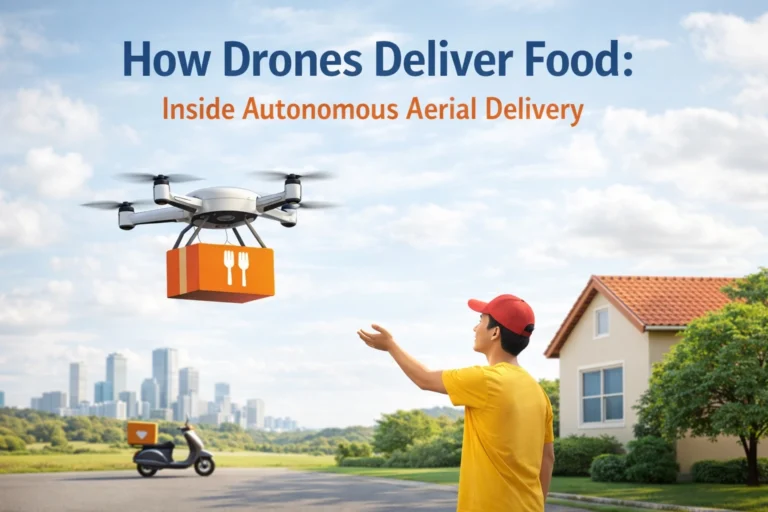
Drone food delivery is rapidly transforming how restaurants move meals from kitchens to customers without relying on traditional drivers or congested roads. In a drone-based delivery ecosystem, restaurants connect with ordering platforms that coordinate preparation, packaging, and aerial dispatch. Specialized drones equipped with navigation sensors, insulated payload boxes, and secure communication systems carry meals directly to customer locations. This ecosystem also includes cloud logistics software, airspace monitoring tools, and automated landing or drop mechanisms that ensure safe delivery. Together, these components create a fast, scalable, contactless distribution model for modern food service networks worldwide today.
Core Operational Concept
At its core, drone food delivery works by linking restaurant kitchens with autonomous aircraft through smart logistics software. Once an order is prepared, the system assigns a nearby drone, calculates a safe flight path, and sends the package toward the customer’s location. Sensors, GPS tracking, and live data help the drone travel safely and deliver food quickly without road delays.
Evolution of Autonomous Food Logistics

Autonomous food logistics has evolved quickly over the past decade as restaurants, delivery apps, and technology companies searched for faster ways to move meals through busy cities. Traditional courier networks depend on traffic conditions, driver availability, and fuel costs, which often slow delivery times. Advances in robotics, artificial intelligence, and lightweight drone engineering opened the door to aerial logistics solutions. Early pilot programs proved that small drones could carry food orders over short urban distances. Today, autonomous delivery systems integrate mapping data, predictive routing, and restaurant platforms to create highly efficient next-generation food delivery networks.
You Might also Like: Best Lawn Remodel Tools | Expert Home Guide
End-to-End Drone Delivery Workflow
The end-to-end drone delivery workflow begins the moment a customer confirms an order in a restaurant or delivery app. Behind the scenes, logistics software instantly evaluates drone availability, battery levels, weather conditions, and distance to the destination. After the meal is securely packaged, it is placed inside a temperature-controlled payload compartment attached to the drone. The system then generates an optimized flight route using GPS mapping, obstacle detection, and airspace rules. During flight, customers track the delivery in real time until the drone safely reaches the drop-off point and completes the automated handoff process smoothly.
Intelligent Order Processing Systems
Intelligent order processing systems play a critical role in making drone food delivery reliable and scalable for restaurants handling large volumes of online requests. When a customer places an order, the platform instantly verifies location accuracy, kitchen preparation time, and drone fleet availability. Advanced algorithms prioritize orders based on distance, urgency, and battery capacity to ensure efficient dispatch. The system also coordinates with restaurant staff so food is packaged exactly when the drone is ready for pickup. This synchronization reduces waiting time, improves freshness,s and keeps aerial delivery operations running smoothly across busy service periods.
Automated Order Routing
Automated order routing software continuously analyzes incoming requests, restaurant capacity, drone location, and weather data to decide which drone should handle each delivery. Instead of manual coordination, intelligent systems assign flights instantly and adjust routes if conditions change. This dynamic decision-making keeps deliveries fast, reduces operational costs, and helps restaurants scale drone logistics without complex human supervision every single time.
Autonomous Flight Navigation
Autonomous flight navigation allows delivery drones to travel safely between restaurants and customer locations with minimal human intervention. Modern delivery drones rely on GPS positioning, onboard sensors, cameras, and obstacle avoidance algorithms to understand their surroundings. Before takeoff, the navigation system maps a precise flight corridor that avoids buildings, powerlines, restricted airspace, and crowded areas. During flight, the drone constantly adjusts altitude, speed, and direction using real-time data from sensors and ground control networks. This autonomous navigation capability ensures accurate delivery,y reduces risk, and supports the reliable expansion of drone food logistics in modern cities.
Precision Delivery Deployment Methods
One of the most important stages in drone food delivery is the final handoff process, where the meal reaches the customer safely. Precision deployment systems allow drones to deliver food accurately, even in tight residential environments. Advanced positioning technology enables drones to hover above a specific location, such as a backyard, driveway, or designated delivery zone. The system verifies GPS coordinates and stabilizes the drone before initiating the drop process. Restaurants and delivery platforms rely on these precise delivery mechanisms to prevent food damage, reduce safety risks, and ensure that the meal arrives fresh exactly where the customer expects it.
Landing vs Winch Delivery
Drone delivery companies mainly use two methods to complete food drop-offs. Some drones land briefly on a safe surface, such as a driveway or landing pad, before releasing the package. Others remain hovering in the air and lower the food using a winch cable system. Winch delivery is especially useful in crowded areas because the drone never needs to touch the ground.
Core Technologies Powering Delivery Drones
Food delivery drones rely on a combination of advanced hardware and intelligent software systems that work together to maintain stable and safe operations. Key components include high-precision GPS modules, flight control processors, obstacle detection cameras, and communication systems that connect drones with ground stations. Lightweight carbon fiber frames help drones carry payloads while maintaining efficient flight performance. In addition, battery management systems monitor energy consumption and flight endurance in real time. These technologies enable drones to navigate complex environments, carry food packages securely, and complete deliveries with minimal human intervention.
Commercial Drone Platforms for Food Delivery
Several commercial drone platforms have been developed specifically for logistics and food delivery applications. These drones are designed to carry small payloads over short to medium distances while maintaining stability and efficiency. Many models use multi-rotor designs, which allow them to hover precisely and land in compact areas. Others combine fixed-wing flight capabilities with vertical takeoff technology to extend range. Restaurants and delivery companies choose drone platforms based on payload capacity, flight time, reliability,y and integration with their logistics software. These commercial systems continue to evolve as aerial delivery becomes more common.
Speed Range and Operational Efficiency
Speed and operational efficiency are major advantages that make drone food delivery attractive for modern restaurants. Most delivery drones travel significantly faster than ground vehicles when navigating short urban routes because they avoid traffic congestion and road delays. Typical delivery drones can reach speeds between 40 and 70 miles per hour, depending on the model and weather conditions. Their operational range usually covers several miles from the restaurant hub, which makes them ideal for local deliveries. By optimizing flight paths and reducing travel distance, drones help restaurants deliver meals faster while maintaining consistent service quality.
Strategic Advantages of Drone Delivery

Drone food delivery offers several strategic benefits that improve efficiency for both restaurants and customers. Faster transportation means meals arrive fresher, which enhances the overall dining experience. Restaurants can expand their delivery radius without hiring additional drivers or managing vehicle fleets. Drone systems also reduce dependency on road infrastructure, allowing deliveries during heavy traffic periods. Additionally, automated aerial delivery supports contactless service, which many customers prefer. These advantages make drone logistics an attractive solution for food businesses looking to improve speed, reduce costs, and stay competitive in a rapidly evolving delivery market.
You Might also Like: Electric Toothbrushes: Deep Clean in Minutes
Ultra-Fast Contactless Distribution
One of the biggest advantages of drone delivery is the ability to move food directly from a restaurant to a customer with minimal human interaction. Because drones travel in straight aerial paths, they often complete deliveries much faster than traditional drivers. Contactless drop-off systems also improve safety and convenience, which has made drone delivery increasingly appealing for modern consumers.
Technical and Operational Constraints
While drone food delivery offers impressive speed and efficiency, it also comes with several technical and operational limitations that companies must address. Weather conditions such as strong winds, rain, and extreme temperatures can affect drone stability and flight safety. Battery capacity also limits how far a drone can travel while carrying food payloads. Urban environments introduce additional challenges, including tall buildings, signal interference, and restricted airspace zones. Restaurants and logistics providers must carefully plan delivery routes and maintain reliable drone fleets to overcome these constraints and ensure consistent service performance in real-world operating conditions.
Airspace Governance and Safety Protocols
Airspace governance plays a critical role in the safe expansion of drone food delivery services. Aviation authorities establish rules that regulate where drones can fly, how high they can operate, and what safety features must be included. Delivery drones must follow strict guidelines related to collision avoidance, remote identification, and communication with ground control systems. Many countries require operators to maintain a visual line of sight or use approved automated monitoring systems. These regulations help protect people’s property and other aircraft while enabling companies to gradually scale drone delivery networks within controlled and responsible aviation frameworks.
Industry Leaders in Drone Food Delivery
Several technology companies and delivery platforms are actively developing drone food delivery programs to transform last-mile logistics. These companies invest heavily in robotics, artificial intelligence navigation software, and lightweight aircraft engineering. Many pilot programs have already demonstrated successful deliveries between restaurants and nearby residential areas. Partnerships between drone manufacturers, food chains, and delivery apps are accelerating innovation across the industry. As drone infrastructure continues to improve, these collaborations are helping establish new standards for automated food logistics and shaping the future of fast, convenient meal delivery services.
Future of Autonomous Food Logistics
The future of autonomous food logistics is expected to expand rapidly as drone technology becomes more reliable and regulatory frameworks continue evolving. In the coming years, drone fleets may operate from dedicated delivery hubs located near restaurants,s grocery stores, and distribution centers. Artificial intelligence systems will manage scheduling, route optimization, and traffic coordination between hundreds of drones operating simultaneously. Integration with smart city infrastructure could allow drones to communicate with building navigation systems and urban airspace management platforms. These advancements will help create a highly efficient aerial logistics network that supports fast on-demand food delivery.
Scalable Drone Delivery Networks
Scalable drone networks will allow delivery companies to operate large fleets that cover entire metropolitan areas. Instead of launching drones from a single location, multiple micro hubs may be placed throughout cities to reduce flight distance and improve efficiency. These distributed systems will allow restaurants to deliver food within minutes while maintaining safe airspace coordination.
Strategic Outlook for Drone-Powered Delivery
Drone-powered delivery represents a major shift in how food moves from kitchens to customers. As technology advances, restaurants will increasingly integrate aerial logistics into their delivery strategies. Faster service, lower operational costs, and improved customer convenience will drive broader adoption across the food industry. However, long-term success will depend on balancing innovation with safety regulations, infrastructure development, and public acceptance. Businesses that invest early in drone delivery technology may gain a competitive advantage by offering faster and more efficient service. In the years ahead, aerial delivery could become a standard component of modern food logistics.
Read More Informative Blogs At Mypasokey