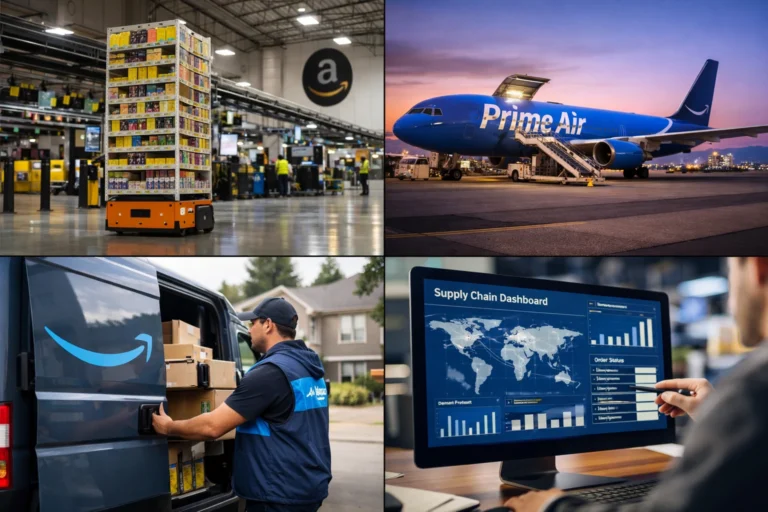
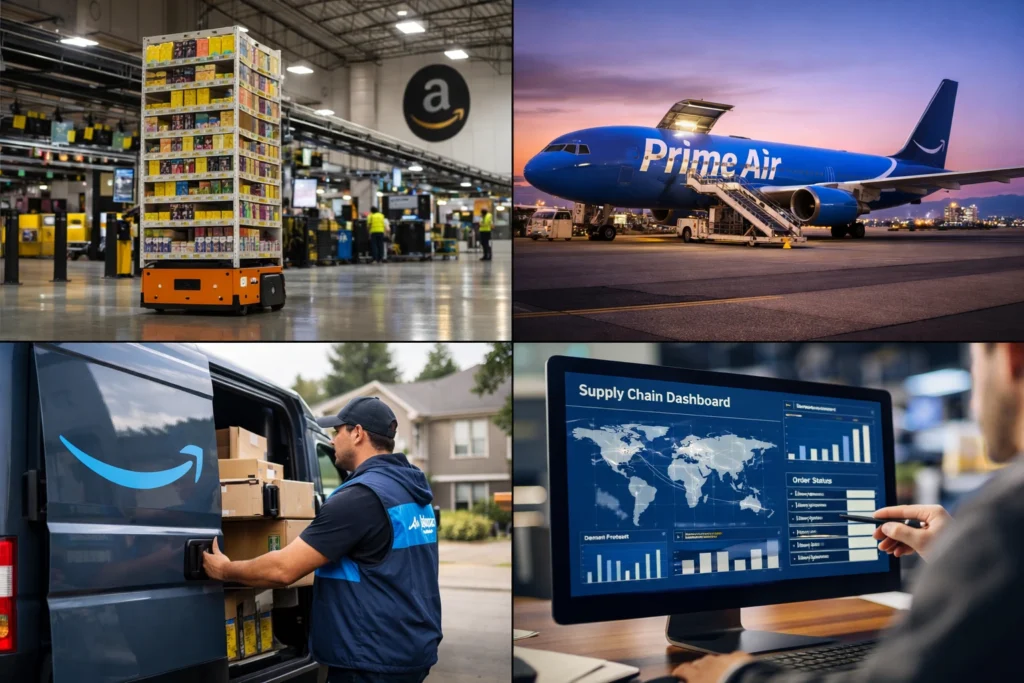

Amazon Supply Chain Ecosystem Overview
Amazon’s supply chain is among the most sophisticated and data-driven systems globally. It is designed to move products from suppliers to customers with remarkable speed, accuracy, and efficiency. Unlike traditional retail, Amazon integrates technology, logistics, warehousing, and delivery into a single connected ecosystem. This allows the company to reduce delays, optimize costs, and continuously improve customer experience. Every step from sourcing to final delivery is tightly monitored and optimized using real-time data and automation. This ecosystem is the backbone of Amazon’s ability to offer fast shipping, reliable service, and scalable operations across global markets.
End-to-End Supply Chain Framework

Amazon’s end-to-end supply chain framework is built to ensure seamless coordination between multiple processes. It starts with product sourcing and moves through transportation, warehousing, order processing, and delivery. Each stage is interconnected, meaning data flows continuously across the system. This integration allows Amazon to anticipate demand, manage inventory efficiently, and reduce bottlenecks. Advanced algorithms and predictive analytics play a key role in keeping everything synchronized. The result is a highly efficient framework that supports millions of daily transactions while maintaining speed, accuracy, and reliability across different regions and markets.
You Might also Like: Top AI Chatbots for Customer Support | Best Tools Guide
Strategic Procurement & Supplier Network
Amazon’s procurement strategy focuses on building strong relationships with global suppliers while maintaining flexibility and cost efficiency. The company works with manufacturers, distributors, and third-party sellers to source a wide range of products. This diverse supplier network helps Amazon maintain product availability and competitive pricing. Additionally, Amazon uses data-driven insights to identify high-demand products and optimize sourcing decisions. By balancing quality, cost, and delivery speed, Amazon ensures that its supply chain remains resilient and capable of adapting to changing market conditions.
Supplier Management & Partnerships
Amazon actively manages its supplier relationships to ensure consistency and reliability. Through performance tracking and data analytics, the company evaluates supplier efficiency, product quality, and delivery timelines. This helps maintain high standards across the supply chain. Amazon also collaborates closely with trusted partners to improve forecasting and reduce disruptions. These strategic partnerships allow the company to scale operations globally while maintaining control over quality and supply consistency.
Inbound Logistics & Global Transportation
Inbound logistics at Amazon focuses on efficiently moving goods from suppliers to fulfillment centers. This process involves multiple transportation modes, including air, sea, and ground shipping. Amazon leverages its own logistics network, along with third-party carriers, to streamline the movement of goods across borders. The company also uses advanced tracking systems to monitor shipments in real time. By optimizing routes and reducing transit time, Amazon ensures that products reach warehouses quickly and are ready for customer orders without unnecessary delays.
Freight & Shipping Optimization
Amazon continuously optimizes its freight operations to reduce costs and improve delivery speed. The company uses data analytics to determine the most efficient shipping routes and transportation methods. By consolidating shipments and leveraging bulk transportation, Amazon reduces overall logistics expenses. Additionally, predictive planning helps minimize delays and ensures timely replenishment of inventory across its global fulfillment network.
Dynamic Inventory Allocation
Dynamic inventory allocation ensures that products are distributed across fulfillment centers based on real-time demand. Amazon uses algorithms to determine where inventory should be placed to minimize delivery time and shipping costs. This approach allows the company to respond quickly to changes in demand and ensures faster order fulfillment for customers across different regions.
Scalable Fulfillment Infrastructure
Amazon’s fulfillment infrastructure is designed to handle massive volumes of orders while maintaining speed and efficiency. The company operates a vast network of fulfillment centers strategically located near major population areas. These centers are equipped with advanced technology and automation systems that streamline storage, picking, and packing processes. This scalability allows Amazon to process millions of orders daily without compromising performance or customer satisfaction.
Fulfillment Center Operations & Optimization
Fulfillment centers are the core of Amazon’s supply chain, where products are stored, processed, and prepared for shipping. These facilities are highly optimized to reduce handling time and increase efficiency. Advanced robotics, conveyor systems, and AI-driven software work together to ensure smooth operations. Each fulfillment center is designed to maximize storage capacity while maintaining fast order processing capabilities.
Fulfillment Center Typologies
Amazon operates different types of fulfillment centers, each serving a specific purpose. Some centers focus on standard products, while others handle specialized categories like perishables or large items. Sortation centers and delivery stations further streamline the distribution process by organizing packages based on delivery routes. This diversified infrastructure helps Amazon manage different product types and delivery requirements efficiently.
Order Orchestration & Processing Systems
Amazon’s order orchestration system is designed to manage millions of orders in real time with precision and speed. Once a customer places an order, the system instantly identifies the nearest fulfillment center, checks inventory availability, and assigns the order to the most efficient processing path. This seamless coordination reduces delays and ensures accurate fulfillment. The system integrates data from multiple sources, enabling quick decision-making and minimizing human intervention. By leveraging automation and intelligent workflows, Amazon ensures that every order moves smoothly through the supply chain without unnecessary bottlenecks.
Automated Pick, Pack & Warehouse Robotics
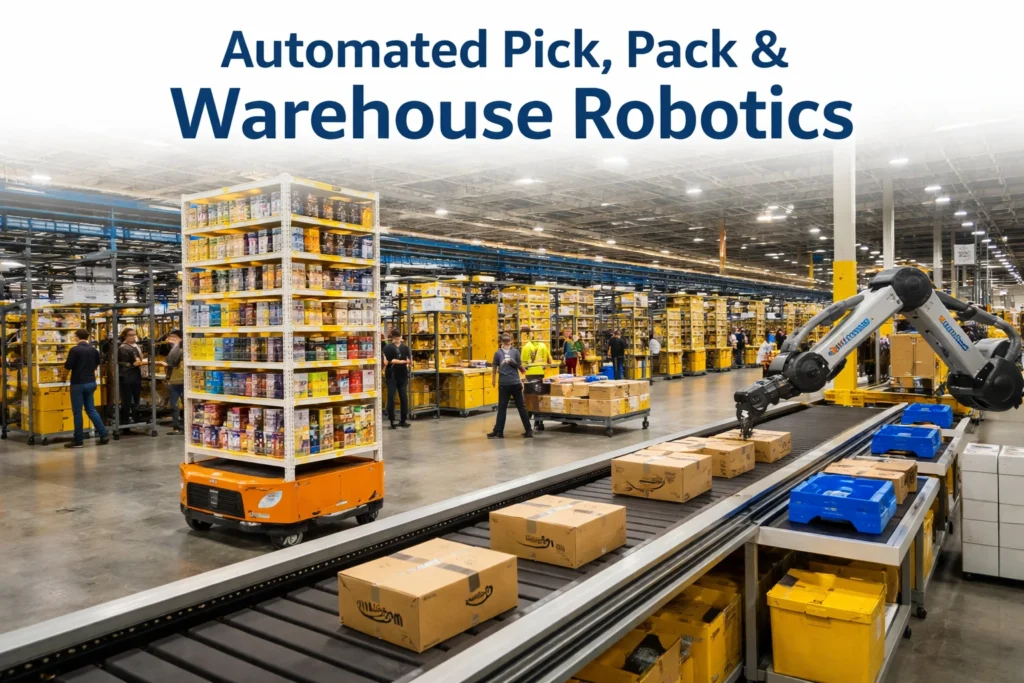
Amazon’s warehouses are powered by advanced automation systems that significantly improve efficiency. The pick-and-pack process is supported by robotics that move shelves, locate products, and assist workers in retrieving items quickly. This reduces physical effort while increasing accuracy and speed. Automation allows Amazon to handle high order volumes while maintaining consistency in operations. The integration of robotics not only accelerates fulfillment but also enhances workplace safety and reduces operational costs across its global warehouse network.
You Might also Like: InnovateHub: Intelligent Innovation Ecosystem & Strategy
Robotics & Warehouse Intelligence
Amazon uses intelligent robots and AI-driven systems to optimize warehouse operations. These robots are capable of navigating complex warehouse layouts, transporting inventory, and working alongside human employees. Machine learning algorithms continuously improve their efficiency by analyzing movement patterns and workflow data. This combination of robotics and intelligence helps Amazon reduce processing time, improve accuracy, and scale operations without sacrificing quality or performance.
Integrated Distribution & Logistics Network
Amazon’s distribution network is a highly coordinated system that connects fulfillment centers, sortation hubs, and delivery stations. This integration ensures that packages are efficiently sorted and routed to their final destinations. The company uses advanced tracking and routing technologies to optimize delivery paths and reduce transit time. By maintaining control over its logistics network, Amazon can respond quickly to changes in demand and ensure reliable delivery performance across different regions and markets.
Fulfillment Models: FBA, FBM & Hybrid Approaches
Amazon offers multiple fulfillment models to support different types of sellers and business needs. Fulfillment by Amazon (FBA) allows sellers to store their products in Amazon’s warehouses, where Amazon handles storage, packing, shipping, and customer service. Fulfillment by Merchant (FBM) gives sellers more control by allowing them to manage their own storage and shipping. Additionally, hybrid approaches combine both models to maximize flexibility and efficiency. These options enable sellers to scale their businesses while leveraging Amazon’s powerful logistics infrastructure.
Artificial Intelligence in Supply Chain Optimization
Artificial intelligence plays a central role in optimizing Amazon’s supply chain operations. AI is used for demand forecasting, inventory management, route optimization, and warehouse automation. Machine learning algorithms analyze massive datasets to identify patterns and improve decision-making processes. This allows Amazon to predict customer needs, reduce operational costs, and enhance overall efficiency. AI-driven systems continuously learn and adapt, making the supply chain smarter and more responsive over time.
Reverse Logistics & Returns Management
Amazon has built a highly efficient reverse logistics system to manage returns and refunds. The process is designed to be simple and customer-friendly, allowing users to return products with minimal hassle. Once a return is initiated, Amazon quickly processes the item, inspects it, and decides whether it can be restocked or needs to be disposed of. Automation plays a key role in streamlining this process, reducing processing time and ensuring a smooth experience. This efficient returns system enhances customer trust and strengthens Amazon’s reputation for reliability.
Global Supply Chain Network & Market Reach
Amazon’s global supply chain network spans multiple continents, enabling the company to serve millions of customers worldwide. With strategically located fulfillment centers and regional hubs, Amazon can efficiently manage cross-border logistics and reduce delivery times. The company adapts its operations based on local regulations, customer preferences, and infrastructure. This global reach allows Amazon to maintain consistent service quality while scaling operations across diverse markets, making it one of the most dominant and flexible supply chain systems in the world.
Amazon Delivery Innovations & Future Technologies
Amazon continuously invests in innovative delivery technologies to improve speed and efficiency. From drone delivery initiatives like Prime Air to automated delivery systems, the company is exploring ways to transform logistics. These innovations aim to reduce delivery time, lower costs, and enhance customer convenience. By integrating advanced technologies into its supply chain, Amazon is preparing for a future where deliveries are faster, smarter, and more automated than ever before.
Advantages of the Amazon Supply Chain Model
Amazon’s supply chain offers several advantages that set it apart from traditional systems. Its high level of automation, data-driven decision-making, and integrated logistics network allows the company to operate at unmatched speed and scale. Customers benefit from faster delivery, better product availability, and reliable service. For sellers, Amazon provides access to a massive infrastructure that simplifies logistics and helps businesses grow efficiently. This combination of benefits makes Amazon’s model highly effective and widely admired in the e-commerce industry.
How Amazon Supply Chain Benefits Businesses & Sellers
Amazon’s supply chain provides significant advantages for businesses and third-party sellers. Through services like FBA, sellers can leverage Amazon’s logistics network without managing warehousing or shipping themselves. This reduces operational complexity and allows sellers to focus on growth and product development. The platform also provides access to a large customer base, faster delivery options, and improved customer trust. As a result, businesses can scale more efficiently while benefiting from Amazon’s established infrastructure.
Amazon Supply Chain vs Traditional Supply Chains
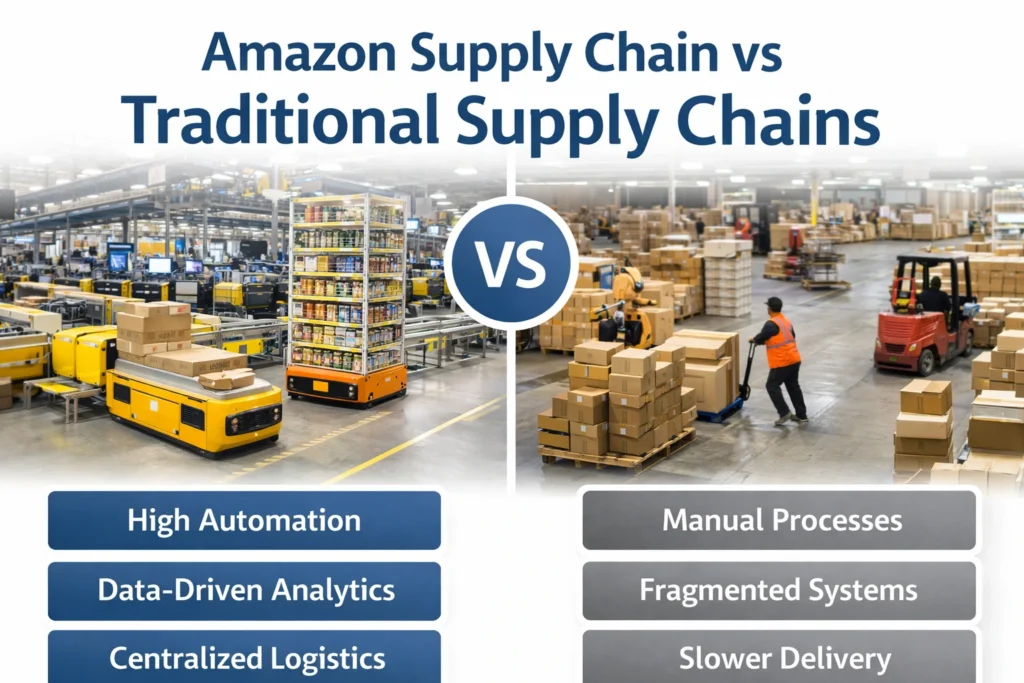
Compared to traditional supply chains, Amazon’s system is far more advanced and integrated. Traditional models often rely on multiple disconnected systems, which can lead to delays and inefficiencies. In contrast, Amazon uses a centralized, data-driven approach that connects all stages of the supply chain. Automation, real-time tracking, and predictive analytics give Amazon a competitive advantage. This allows the company to deliver products faster, reduce costs, and maintain higher levels of accuracy and customer satisfaction.
Future of Amazon Supply Chain
The future of Amazon’s supply chain is focused on further automation, sustainability, and technological innovation. The company is investing heavily in AI, robotics, and green logistics to improve efficiency while reducing environmental impact. Sustainable packaging, electric delivery vehicles, and optimized energy usage are part of its long-term vision. The technology continues to evolve, Amazon’s supply chain is expected to become even more intelligent, efficient, and environmentally responsible.
Conclusion
Amazon’s supply chain is a powerful example of how technology and logistics can work together to create a seamless customer experience. The sourcing and inventory management to delivery and returns, every step is carefully optimized for speed, accuracy, and efficiency. Its reliance on AI, automation, and data-driven insights allows Amazon to stay ahead of the competition. Understanding how Amazon’s supply chain works provides valuable insights into modern logistics and the future of global e-commerce operations.
Read More Informative Information At Mypasokey