

Top 5 Email Marketing Platforms for Growth (2026)
Introduction
Email marketing in 2026 is still one of the most powerful and cost-effective digital growth channels for businesses of all sizes. While social media platforms constantly change algorithms and paid ads keep getting more expensive, email gives you something unique: direct access to your audience. Modern email marketing is no longer just about sending newsletters; it is about building automated customer journeys, increasing lifetime value, and driving predictable revenue growth. In this guide, we will explore the best email marketing platforms that help businesses scale efficiently, improve engagement, and turn subscribers into loyal customers through smarter automation and personalization.
Comparison of Leading Email Marketing Platforms (2026)
Choosing the right email marketing platform can significantly impact your business growth, especially in 2026, when automation and data-driven marketing are essential. Each platform offers different strengths depending on business type, budget, and goals. Some tools are designed for beginners who need simplicity, while others focus on advanced automation and eCommerce integration. In this section, we compare the top platforms based on usability, features, scalability, and performance. This quick overview helps you understand which tool aligns best with your strategy before diving into detailed breakdowns of each option.
You might also like: Miuzo Explained: A Modern Framework for Productivity & Growth
What Defines an Effective Email Marketing Platform
A strong email marketing platform is more than just a tool for sending emails it is a complete growth system. In 2026, effectiveness is measured by automation capabilities, segmentation intelligence, deliverability rates, and integration flexibility. The best platforms allow businesses to create personalized customer journeys based on real-time behavior and engagement. They also provide advanced analytics to track performance and optimize campaigns. A truly effective platform should be scalable, easy to use, and capable of supporting long-term business growth without requiring complex technical setup or constant manual management.
1. Mailchimp – Ideal for Small Businesses
Mailchimp remains one of the most popular email marketing platforms for beginners and small businesses due to its simplicity and ease of use. It offers drag-and-drop email builders, basic automation, and ready-made templates that help users launch campaigns quickly. While it may not be the most advanced platform, it is highly reliable for businesses starting their email marketing journey. Mailchimp also provides useful analytics and audience segmentation tools, making it a solid entry-level choice for brands that want to grow without dealing with complex configurations or steep learning curves.
Mailchimp Overview for Beginners
Mailchimp is designed for users who want a simple and intuitive way to manage email campaigns without technical complexity. It offers essential features like email templates, basic automation, and audience tracking. While it lacks advanced segmentation and deep automation found in enterprise tools, it is still highly effective for startups and small businesses. Its user-friendly dashboard makes it easy to create, schedule, and analyze campaigns, helping new marketers build confidence and grow their audience steadily.
2. HubSpot – Comprehensive Marketing Solution
HubSpot is a powerful all-in-one marketing platform that combines email marketing with CRM, sales, and automation tools. It is designed for businesses that want a unified system to manage customer relationships and marketing campaigns in one place. HubSpot’s strength lies in its deep integration between marketing and sales data, allowing businesses to create highly personalized and automated workflows. It is especially effective for B2B companies that rely on lead nurturing and long sales cycles to convert prospects into customers.
HubSpot Overview for Businesses
HubSpot provides a complete marketing ecosystem that goes beyond email campaigns. It includes CRM integration, lead tracking, automation workflows, and advanced analytics. Businesses can build detailed customer journeys based on behavior and engagement data. While it may be more expensive than basic tools, its value comes from consolidation, replacing multiple tools with one platform. For companies focused on scaling operations and improving customer relationships, HubSpot delivers strong long-term growth potential.
3. Klaviyo – Specialized for eCommerce
Klaviyo is widely recognized as one of the best email marketing platforms for e-commerce businesses. It is built around data-driven marketing, allowing brands to use customer behavior, purchase history, and browsing activity to create highly targeted campaigns. Its automation capabilities are particularly strong for abandoned cart emails, product recommendations, and post-purchase engagement. Klaviyo helps online stores maximize revenue by turning customer data into personalized marketing strategies that drive repeat purchases and long-term loyalty.
Klaviyo Overview for Online Stores
Klaviyo focuses heavily on eCommerce integration, making it a top choice for Shopify, WooCommerce, and other online store platforms. It allows businesses to create advanced segmentation based on real-time customer behavior. This enables highly personalized campaigns that significantly improve conversion rates. Its analytics tools also provide deep insights into revenue attribution, helping brands understand exactly how email marketing contributes to sales performance and customer retention.
4. Brevo – Cost-Effective Email Platform
Brevo (formerly Sendinblue) is a budget-friendly email marketing platform designed for businesses that want powerful features without high costs. It offers email campaigns, SMS marketing, automation workflows, and CRM tools in one platform. Brevo is especially useful for startups and small businesses that need scalability without heavy investment. Despite its affordability, it still provides strong deliverability and automation features that support consistent marketing performance.
Brevo Overview for Budget Users
Brevo is ideal for businesses that want multi-channel marketing without managing multiple tools. It combines email, SMS, and automation in a single dashboard. While it may not be as advanced as enterprise-level platforms, it covers all essential marketing needs effectively. Its pricing structure makes it accessible for growing businesses, while still offering enough functionality to support long-term scaling and customer engagement.
5. GetResponse – Advanced Automation Platform
GetResponse is a feature-rich email marketing platform known for its advanced automation and funnel-building capabilities. It allows businesses to create complete marketing funnels that guide users from awareness to conversion. With tools like webinars, landing pages, and autoresponders, GetResponse goes beyond traditional email marketing. It is ideal for businesses that want to build structured customer journeys and optimize conversions through automation.
GetResponse Overview for Funnels
GetResponse provides powerful automation tools that help marketers design complete sales funnels. It includes features like behavioral triggers, lead scoring, and conversion tracking. These tools allow businesses to nurture leads more effectively and increase conversion rates. While it may require a slight learning curve, its advanced capabilities make it a strong choice for marketers focused on performance and funnel optimization.
Key Features of Modern Email Marketing Platforms
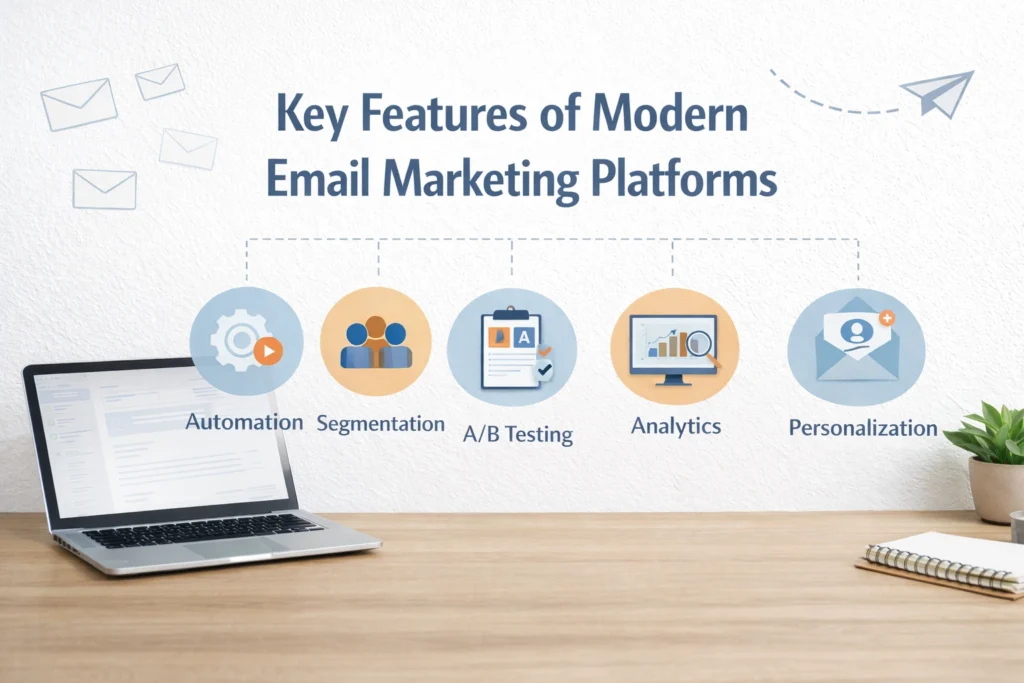
Modern email marketing platforms in 2026 are no longer limited to sending campaigns. They are full-scale marketing systems designed to automate customer journeys, improve targeting, and maximize revenue. The most effective platforms combine automation, data analytics, personalization, and integrations into one seamless ecosystem. Businesses now rely on these features to reduce manual work and improve marketing efficiency. Without these core capabilities, it becomes difficult to compete in today’s data-driven environment where customer expectations are higher, and attention spans are shorter than ever.
You might also like: Notion vs Evernote: Which Is Better in 2026? | Ultimate Comparison
Automation
Automation is the foundation of modern email marketing success because it allows businesses to send the right message at the right time without manual effort. Through automated workflows, companies can trigger emails based on user behavior such as sign-ups, purchases, or abandoned carts. This ensures timely communication that feels personalized and relevant. In 2026, advanced automation also includes AI-based triggers, helping brands predict customer actions and respond proactively, which improves engagement and drives higher conversion rates across campaigns.
Segmentation
Segmentation allows businesses to divide their audience into meaningful groups based on behavior, interests, purchase history, and demographics. Instead of sending one generic message to everyone, marketers can create highly targeted campaigns for specific customer segments. This leads to better engagement and higher conversion rates. Advanced platforms now use real-time data to update segments automatically, ensuring that messaging stays relevant as customer behavior changes. This makes segmentation one of the most powerful tools in modern email marketing strategies.
Analytics
Analytics plays a critical role in understanding campaign performance and optimizing future strategies. Modern platforms provide detailed insights into open rates, click-through rates, conversions, and revenue attribution. This data helps marketers identify what works and what needs improvement. In 2026, analytics has become more advanced with predictive insights and AI-driven recommendations. Businesses can now make smarter decisions based on real performance data rather than assumptions, leading to more efficient and profitable email marketing campaigns.
Deliverability
Deliverability ensures that emails actually reach the inbox instead of landing in spam folders. This depends on factors like sender reputation, authentication protocols, and content quality. Even the best-designed campaigns fail if they don’t reach the audience. That’s why top email platforms invest heavily in deliverability infrastructure. In 2026, tools will also use AI to monitor engagement signals and automatically adjust sending behavior, helping businesses maintain strong inbox placement and consistent communication with their subscribers.
Integrations
Integrations allow email marketing platforms to connect with other tools such as CRMs, eCommerce platforms, and analytics systems. This creates a unified marketing ecosystem where data flows seamlessly across applications. With strong integrations, businesses can build more personalized and data-driven campaigns. For example, connecting an online store with an email platform enables real-time product recommendations and behavior-based messaging. This level of connectivity is essential for scaling marketing efforts efficiently in a competitive digital environment.
Benefits of Email Marketing for Business Growth
Email marketing continues to be one of the highest ROI channels for business growth because it provides direct access to customers without relying on third-party algorithms. It helps businesses build long-term relationships, increase customer retention, and drive repeat sales. Unlike paid advertising, email marketing is cost-effective and scalable. In 2026, businesses use email not just for promotions but for onboarding, engagement, and lifecycle marketing. This makes it a critical part of any digital growth strategy, regardless of industry or business size.
How to Choose the Right Email Marketing Platform
Choosing the right email marketing platform depends on your business goals, budget, and technical requirements. Some businesses need simple tools for sending newsletters, while others require advanced automation and CRM integration. The best approach is to evaluate platforms based on scalability, ease of use, integration options, and analytics capabilities. It is also important to consider long-term growth potential rather than just short-term needs. A platform that fits your current stage but also supports future expansion is always the smartest investment.
Common Mistakes to Avoid When Choosing an Email Marketing Tool
Many businesses make the mistake of choosing an email platform based only on price or popularity without considering long-term needs. Another common mistake is ignoring scalability, which leads to switching platforms later and losing data or momentum. Some businesses also overlook deliverability and integration capabilities, which can significantly impact performance. In 2026, the biggest mistake is failing to align the platform with business goals. The right tool should support automation, personalization, and growth not just basic email sending.
Conclusion
Choosing the right email marketing platform in 2026 is not just a technical decision it is a strategic growth decision that directly impacts your business revenue, customer engagement, and long-term scalability. With so many advanced tools available, the focus should be on finding a platform that matches your business model, automation needs, and budget. Whether you are a beginner using Mailchimp, a growing brand leveraging Brevo, or an enterprise using HubSpot or Klaviyo, each platform serves a unique purpose. The key takeaway is simple: the right email marketing system can turn your audience into a predictable and scalable revenue stream when used effectively.
Frequently Asked Questions (FAQs)

What is the best overall email marketing platform in 2026?
There is no single best platform; it depends on your needs, but HubSpot and Klaviyo are top choices for most businesses.
Do I need technical skills to use email marketing platforms?
No, most platforms are beginner-friendly with drag-and-drop tools and ready-made automation templates.
Which email marketing platform offers the best automation features?
ActiveCampaign and GetResponse are best known for advanced and flexible automation workflows.
Is email marketing still profitable for small businesses?
Yes, it offers high ROI and helps small businesses grow without heavy advertising costs.
Can email marketing replace social media marketing?
No, but it works best alongside social media for conversions and customer retention.
Read More Informative Information At Mypasokey