
WordPress vs Custom Coding: Which Is Better for Your Website?
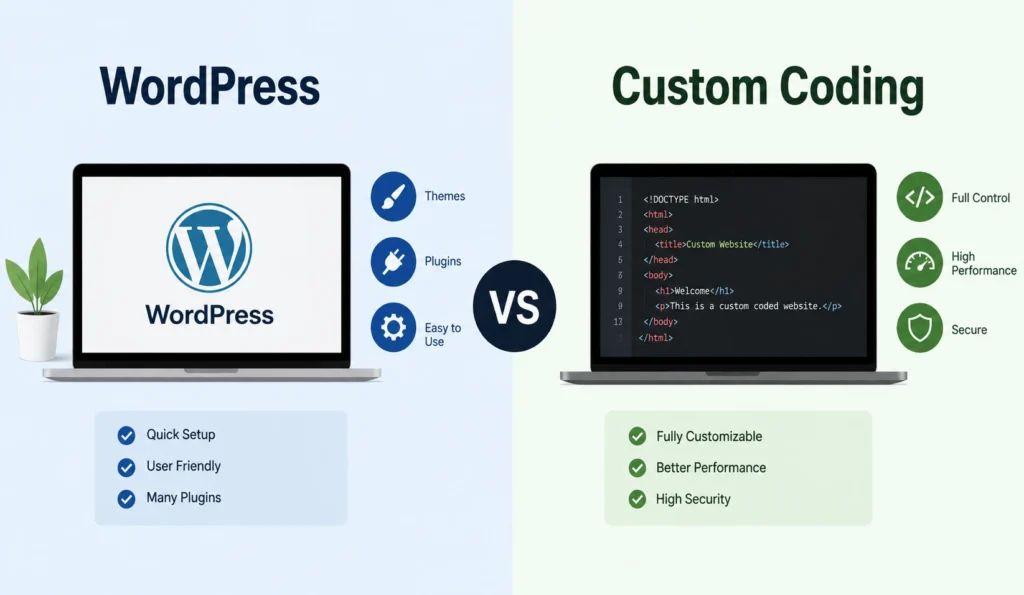
Choosing between WordPress and custom coding is one of the most important decisions when building a website today. Both options power millions of sites across the internet, but they work in very different ways. WordPress is a ready-made content management system that allows users to build websites quickly using themes and plugins. Custom coding, on the other hand, means building everything from scratch using programming languages like HTML, CSS, JavaScript, and backend frameworks. In this guide, we’ll break down both approaches in a simple, practical way so you can clearly understand which one fits your business goals, budget, and long-term digital strategy better in real-world scenarios.
WordPress vs Custom Coding: Key Differences
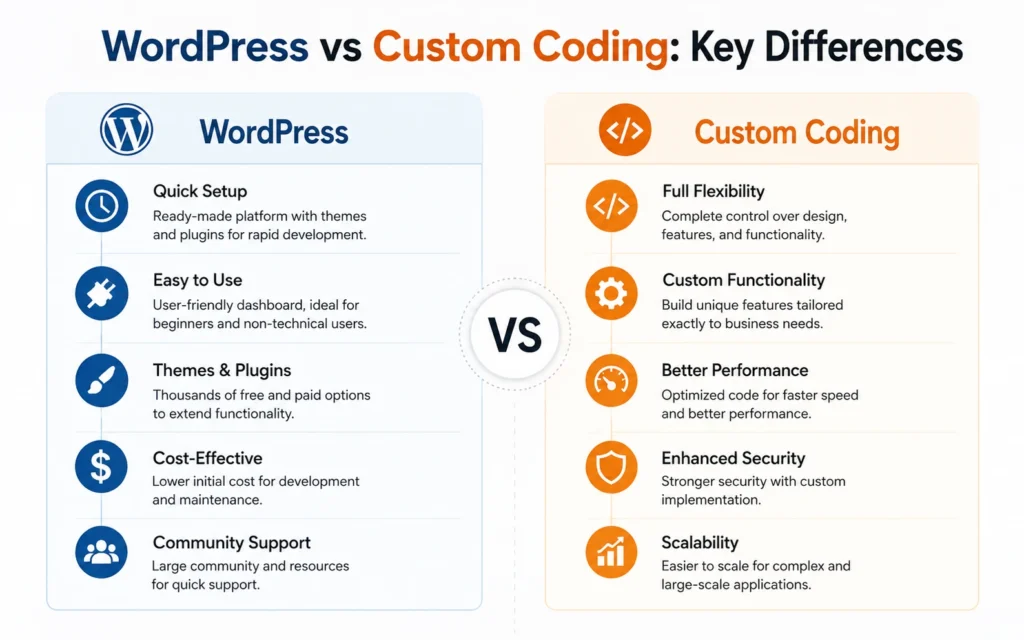
And WordPress and custom coding differ mainly in how websites are built and managed. WordPress offers a pre-built system where users can install themes and plugins to create websites without deep technical knowledge. Custom coding requires developers to design and build every feature manually, offering complete freedom but also requiring more time and cost. WordPress is ideal for faster launches and easier maintenance, while custom coding is better for complex, scalable applications. According to W3Techs, WordPress powers over 40% of all websites globally, showing its dominance in simplicity and accessibility, while custom-built sites remain preferred for advanced, high-performance digital products.
💚 You might also like: Best Frameworks for Web Development: Complete 2026 Guide
Key Features of WordPress
WordPress stands out because it simplifies website creation for everyone, from beginners to professionals. It provides a ready-to-use ecosystem where users can build, manage, and scale websites without needing advanced coding skills. With thousands of plugins and themes, WordPress allows fast customization for blogs, business sites, and even online stores. It also supports SEO tools, media management, and integrations with third-party services. Its open-source structure helps keep it affordable and ensures strong community support worldwide. However, its simplicity sometimes comes at the cost of flexibility, especially when compared to fully custom-coded solutions built for highly specific business requirements or performance-heavy applications.
User-Friendly Management
WordPress is known for its simple and intuitive dashboard, making it easy for non-technical users to manage content. You can create pages, publish blogs, upload images, and update your website without writing code. This ease of use is one of the main reasons businesses choose WordPress over custom development. It reduces dependency on developers for everyday updates and allows teams to manage content efficiently, saving both time and operational costs in the long run.
Plugin and Theme Ecosystem
One of WordPress’s strongest advantages is its massive library of plugins and themes. With over 60,000 plugins available, users can add features like SEO tools, contact forms, security systems, and e-commerce functionality in just a few clicks. Themes allow quick design changes without coding. This ecosystem makes WordPress highly flexible and scalable for most standard business needs, reducing development time significantly while offering a wide range of customization options.
Rapid Development
WordPress enables extremely fast website development compared to custom coding. A basic website can be launched in a few days using pre-built themes and plugins. This speed is ideal for startups and small businesses that need an online presence quickly. Instead of building everything from scratch, developers can focus on configuration and customization, which significantly reduces project timelines and allows faster market entry.
Key Features of Custom Coding
Custom coding offers complete control over how a website looks, feels, and performs. Unlike WordPress, there are no limitations imposed by themes or plugins. Developers build everything from scratch, allowing highly optimized and unique digital experiences. This approach is commonly used for enterprise platforms, SaaS products, and complex web applications where performance, scalability, and security are critical. While it requires more time and investment, custom coding ensures that every feature is built specifically for business needs, resulting in better long-term flexibility and system architecture.
Complete Flexibility
Custom coding provides unlimited flexibility in design and functionality. Developers are not restricted by pre-built templates or plugin limitations. Every element of the website can be designed exactly as required, making it ideal for brands that want a unique identity or complex system behavior. This level of freedom allows businesses to create highly customized user experiences that stand out in competitive markets.
Custom Functionality
With custom coding, every feature is built specifically for the project. Whether it’s advanced booking systems, AI integrations, or complex dashboards, developers can create anything without relying on third-party plugins. This reduces dependency on external tools and ensures that functionality aligns perfectly with business requirements, improving performance and reliability in the long term.
Performance Control
Custom-coded websites offer superior performance control because there is no unnecessary code or plugin bloat. Developers can optimize every line of code for speed and efficiency. This results in faster loading times and better scalability under high traffic conditions. According to Google’s Core Web Vitals guidelines, performance plays a major role in SEO rankings, making custom coding a strong choice for performance-focused projects.
WordPress vs Custom Coding Comparison Table
| Feature | WordPress | Custom Coding |
| Ease of Use | Very easy for beginners with no coding knowledge | Requires professional developers |
| Development Speed | Fast setup using themes and plugins | Slow due to full custom development |
| Cost | Low to medium cost | High development cost |
| Customization | Limited by themes and plugins | Fully unlimited customization |
| Performance | Depends on plugins and optimization | Highly optimized and faster by default |
| SEO Capabilities | Strong with SEO plugins | Strong with full technical control |
| Security | Depends on updates and plugins | More secure if properly built |
| Scalability | Good for small to medium sites | Excellent for large-scale systems |
| Maintenance | Needs regular updates | Controlled but developer-dependent |
| Best For | Blogs, small businesses, and e-commerce | SaaS, enterprise apps, complex platforms |
WordPress vs Custom Coding: Comparison
When comparing WordPress and custom coding side by side, the key difference is control versus convenience. WordPress focuses on speed, ease of use, and affordability, making it ideal for users who want quick results without technical complexity. Custom coding focuses on full control, performance, and scalability, which is better for complex systems. Both can achieve strong SEO rankings, but their approach is different. WordPress relies on plugins, while custom coding depends on manual optimization and architecture design.
💚 You might also like: Best Courses for Freelancers in 2026 | Top Skills to Learn
Ease of Use
WordPress is designed for non-technical users, offering a simple dashboard to manage everything without coding. Custom coding is developer-driven, meaning even small changes require technical knowledge. This makes WordPress much more accessible for beginners and business owners.
Development Time
WordPress websites can be launched quickly using ready-made themes and plugins, often within days. Custom-coded websites take longer because every feature is built from scratch, tested, and optimized. This makes WordPress better for fast launches.
Customization
WordPress offers good customization, but within the limits of themes and plugins. Custom coding removes all restrictions, allowing developers to build fully unique designs and features tailored to specific business needs.
Performance
WordPress performance depends on hosting, plugins, and optimization. If poorly managed, it can slow down. Custom-coded websites are generally faster because they include only necessary code and are optimized from the ground up.
SEO
WordPress provides strong SEO support through plugins like Rank Math and Yoast SEO. Custom coding allows deeper technical SEO optimization, including faster loading speed and cleaner code structure, which can improve rankings.
Security
WordPress security depends on regular updates and plugin quality. Because it is widely used, it is a common target for attacks. Custom-coded websites are more secure when built properly, as they have fewer external dependencies.
Scalability
WordPress can scale with proper optimization, but may face limitations with very large systems. Custom-coded solutions are designed for scalability from the start, making them better for enterprise-level applications.
Maintenance
WordPress requires frequent updates for plugins and themes, which can sometimes cause issues. Custom-coded websites require developer support but are more stable due to fewer third-party dependencies.
Cost
WordPress is cost-effective because it reduces development time and uses pre-built systems. Custom coding is expensive due to higher development effort, but it can deliver better long-term value for complex projects.
Pros and Cons of WordPress vs Custom Coding
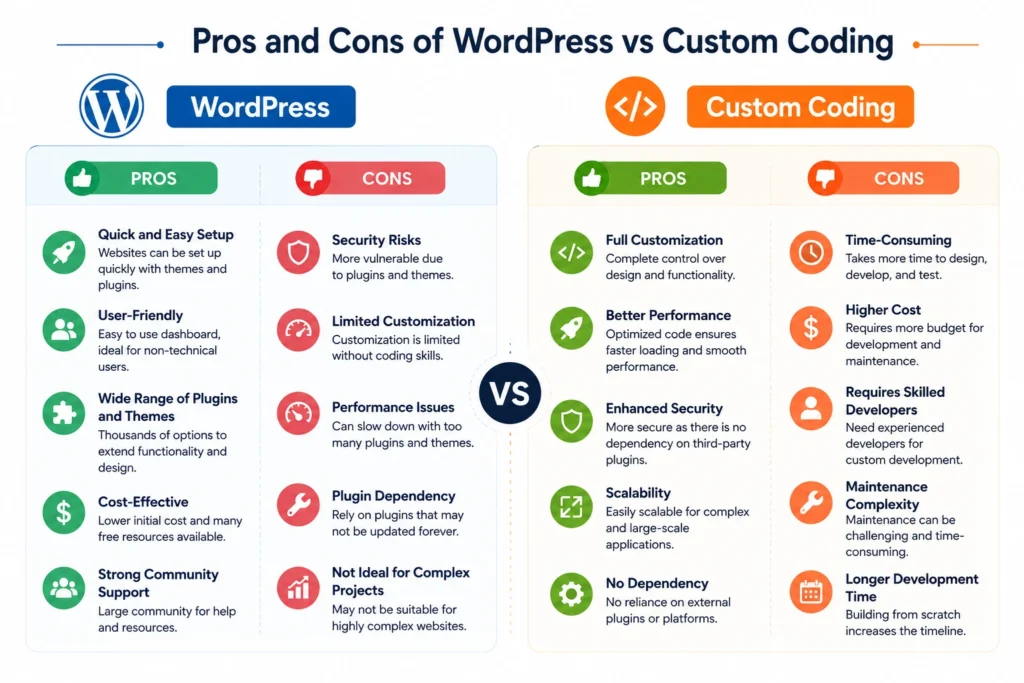
When comparing WordPress and custom coding, it’s important to understand that both are powerful but built for different types of users and projects. WordPress focuses on speed, simplicity, and accessibility, which makes it ideal for beginners and businesses that want to launch quickly without heavy technical work. On the other hand, custom coding is designed for full control, scalability, and performance optimization, but it requires more time, budget, and technical expertise. In real-world development, the right choice depends on balancing cost, flexibility, and long-term business goals rather than assuming one is always better than the other.
Advantages of WordPress
WordPress offers a fast and cost-effective way to build websites without deep coding knowledge. It comes with thousands of themes and plugins that make customization easy for almost any type of website, from blogs to online stores. Its user-friendly dashboard allows non-technical users to manage content easily. WordPress also has strong community support and SEO-friendly tools, making it a practical choice for small businesses and startups that need a quick online presence and simple website management.
Limitations of WordPress
Despite its flexibility, WordPress has limitations. Performance can decrease if too many plugins are used or if the website is not properly optimized. Security risks are higher because it relies heavily on third-party plugins and regular updates. Advanced customization may also require coding knowledge, which reduces its simplicity advantage. For highly complex or large-scale applications, WordPress can feel restrictive compared to fully custom-built solutions.
Advantages of Custom Coding
Custom coding provides complete control over design, functionality, and performance. Developers can build exactly what the project requires without relying on pre-built themes or plugins. This results in cleaner code, better speed optimization, and stronger scalability. It is especially useful for SaaS platforms, enterprise systems, and applications with unique workflows. Custom-coded websites also allow stronger security implementation because everything is built and controlled internally.
Limitations of Custom Coding
The main drawback of custom coding is cost and development time. Building everything from scratch requires skilled developers and longer project timelines. Maintenance and updates also depend on technical expertise, making it less convenient for non-technical users. Even small changes may require developer involvement, which can slow down content updates or feature additions. For simple websites, this approach can be more complex than necessary.
Which Option Is Right for You?
Choosing between WordPress and custom coding depends on your goals, budget, and technical requirements. If you need a fast, affordable, and easy-to-manage website, WordPress is usually the better choice. It works well for blogs, small business sites, and standard e-commerce stores. However, if your project requires advanced functionality, high performance, or unique system architecture, custom coding is a stronger long-term investment. The right decision is not about which one is “best overall,” but which one aligns with your business stage, growth plans, and technical complexity.
Frequently Asked Questions
Is WordPress better than custom coding for most websites?
For most small to medium websites, yes. WordPress allows quicker development, simpler management, and lower overall costs. However, for complex applications or enterprise systems, custom coding provides better performance, flexibility, and scalability in the long run.
Are custom-coded websites faster than WordPress websites?
In most cases, yes. Custom-coded websites are usually faster because they are built with only the necessary code and optimized architecture. WordPress sites can also be fast, but only if properly optimized with good hosting and minimal plugin usage.
Which option is better for SEO?
Both can rank well on Google. WordPress is easier for beginners due to SEO plugins like Rank Math and Yoast. Custom coding allows deeper technical SEO control, such as faster load times and cleaner code, which can give a slight advantage.
Is WordPress secure enough for business websites?
Yes, WordPress is secure if properly maintained with updates, strong hosting, and trusted plugins. However, because it is widely used, it is also more frequently targeted by hackers compared to custom-coded websites.
Which option is more cost-effective?
WordPress is more cost-effective for most users because it reduces development time and uses pre-built tools. Custom coding requires a higher upfront investment but can provide better long-term value for complex projects.
Can WordPress handle large websites?
Yes, WordPress can handle large websites if properly optimized with good hosting, caching, and architecture. However, extremely high-traffic or complex platforms often achieve better performance with custom-coded solutions.
When should I choose custom website development?
And You should choose custom development when you need advanced features, high scalability, unique design systems, or enterprise-level applications that cannot be efficiently built using plugins or templates.
Can I migrate from WordPress to custom coding later?
Yes, migration is possible, but it requires planning and development effort. Such Data as content, users, and SEO structure can be transferred, but the new system must be rebuilt from scratch.
Conclusion
Both WordPress and custom coding are powerful in their own way, but they serve different purposes. WordPress is best for speed, simplicity, and affordability, making it ideal for most standard websites. Custom coding is more suitable for platforms that require high performance, strong scalability, and advanced customization. Instead of thinking which one is universally better, the smarter approach is to match the solution with your business needs. If you prioritize speed and ease, choose WordPress. If you value control and scalability, custom coding offers a more powerful long-term investment.
Read More Informative Information At Mypasokey